Everything you need.
One platform.
Six modules. Both parts of the RTR DGCA exam. Every link below opens the real thing.
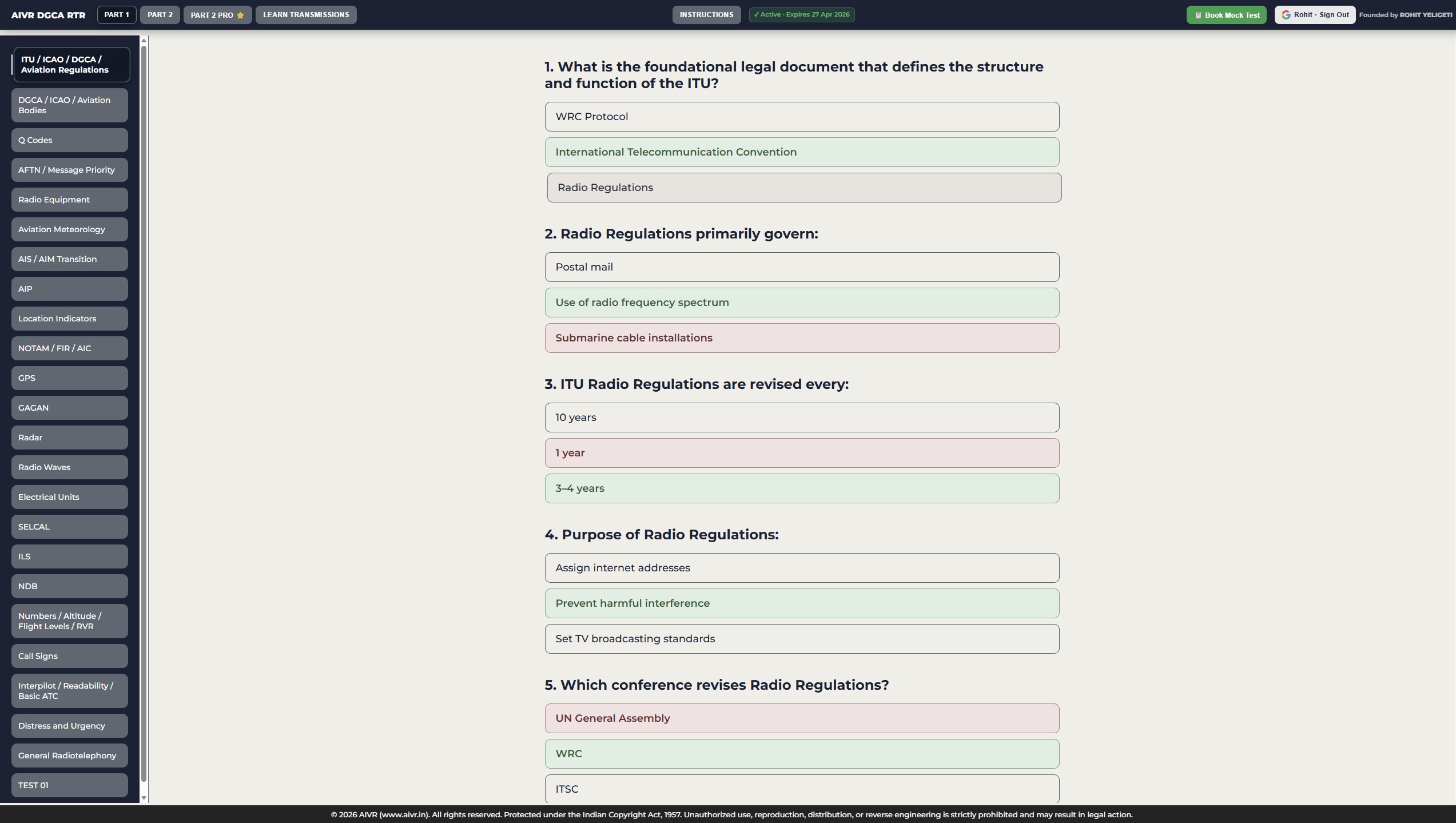
RTR Part 1 — Question Bank
Complete MCQ bank across 23 chapters. Regulations, ICAO procedures, radio waves, GPS, ILS, NDB, SELCAL and more — with instant answer feedback.
Explore Part 1RTR Part 2 — Simulator
Interactive radiotelephony simulator built on ICAO DOC 9432. All 6 flight phases — Parked, Taxi, Departure, Enroute, Emergency, Arrival.
Explore Part 2Part 2 Pro Scenarios
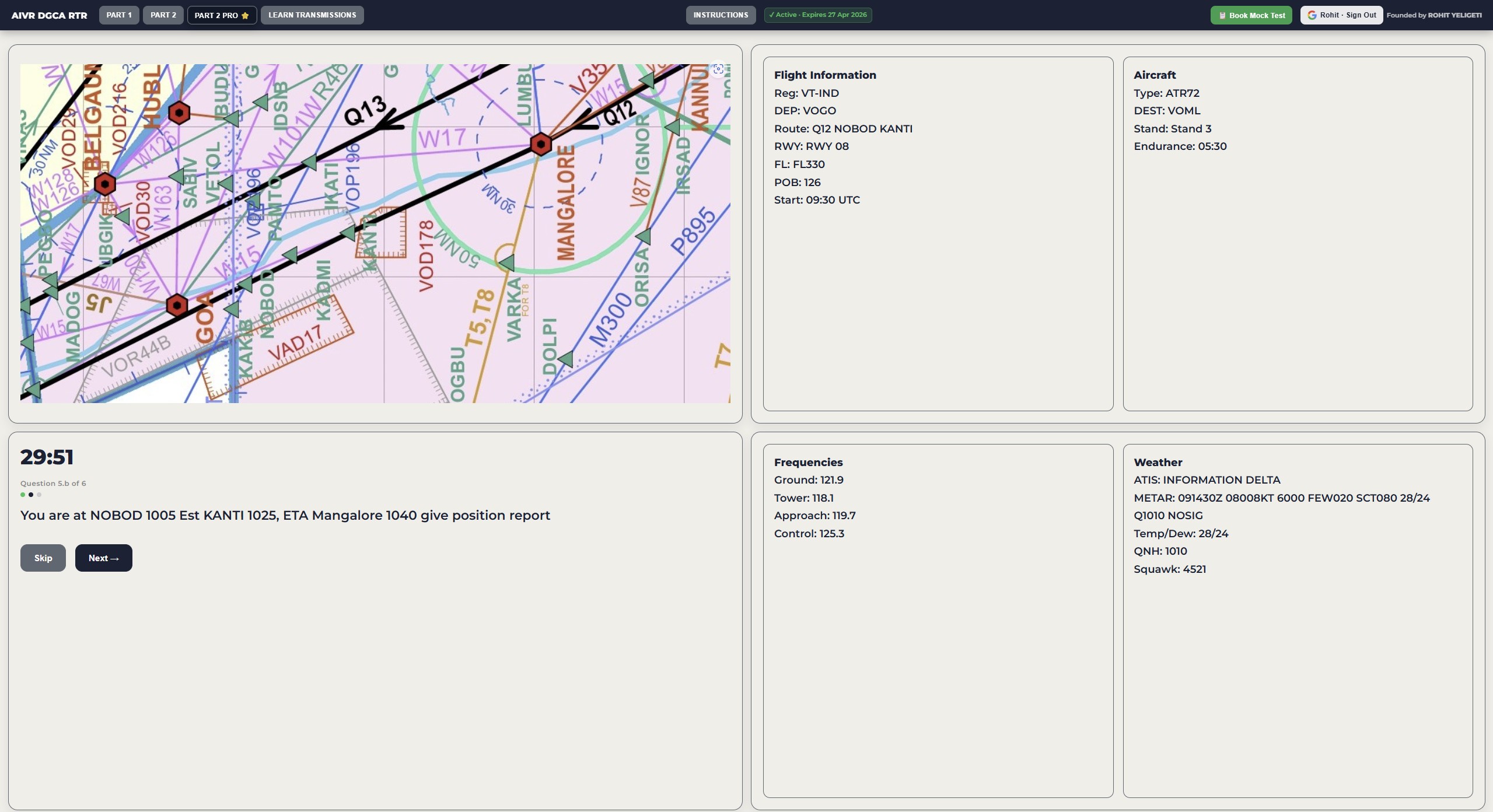
Exam-hall replicas with fixed flight data, frequencies and weather. 10 free AIVR Points with every subscription.
Explore ProLearn Transmissions
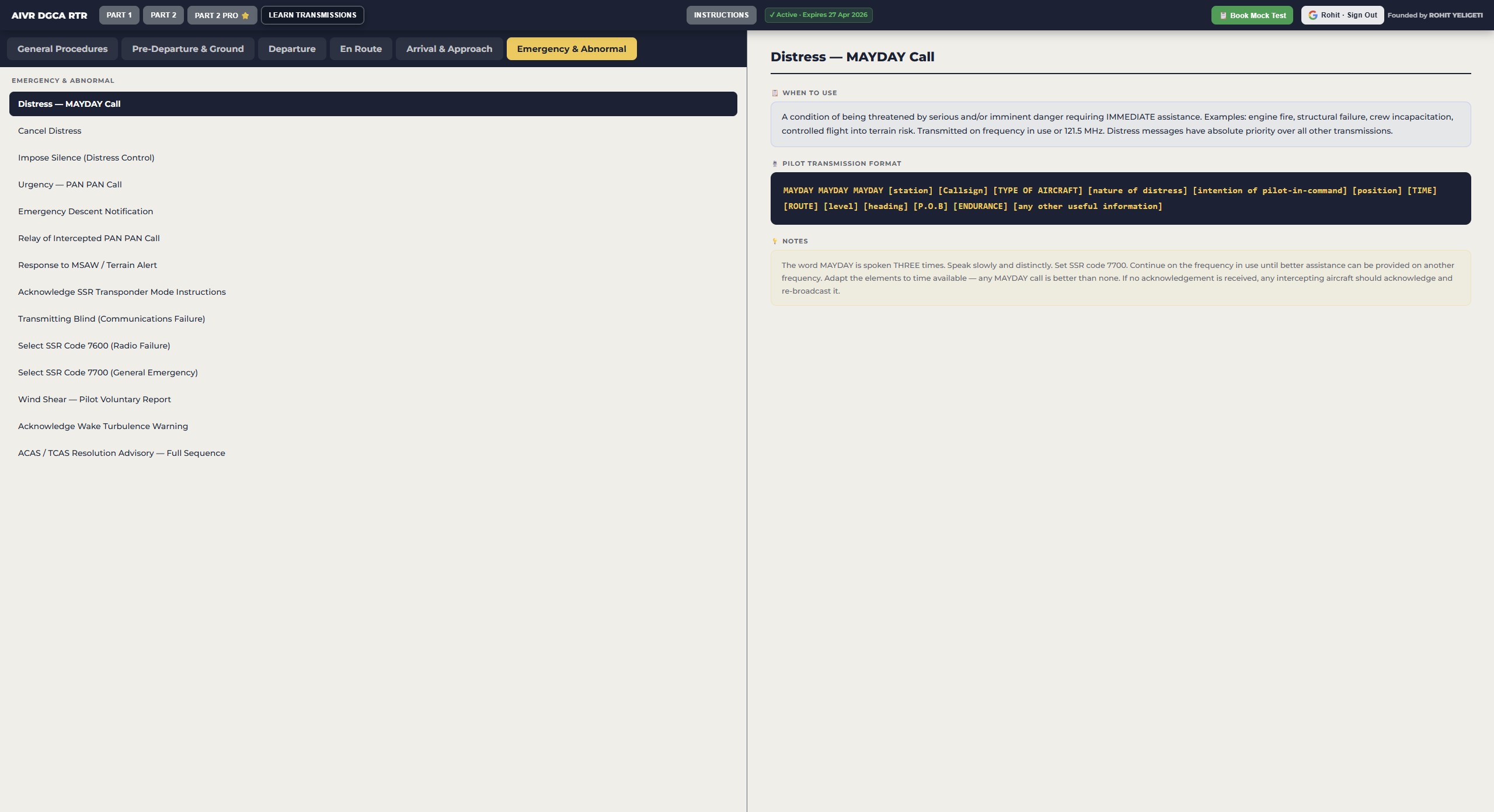
The complete ICAO transmission formats library — what to say and when, section by section.
Explore formats1-on-1 Live Mock Test
Panel-style RTR Part 2 simulation by the AIVR team. All 6 phases, exactly like exam day.
Book a slotRecorded Part 2 Classes
Fast Track (8 classes) or PRO (14 classes) on video, taught by Rohit Yeligeti. Free demo included.
View classesPRO Classes — the extended course
The extended 14-class run, 12+ hours of video: examiner traps, special & conditional clearances, unusual situations and real DGCA papers solved.
View PRO classes23 chapters.
Zero surprises.
Every topic the DGCA RTR Part 1 paper can throw at you, drilled as MCQs with instant feedback — ITU, ICAO, Q codes, radio aids, distress & urgency, all of it.
Speak ICAO,
fluently.
The exam panel doesn't want English — it wants DOC 9432 phraseology. Browse every transmission format by section and learn exactly when and how to use each one.
The exam is six phases.
Fly them all, daily.
Keep scrolling — this is the profile the DGCA RTR Part 2 panel runs you through, and the exact one AIVR's simulator drills.
The exam hall,
before the exam hall.
Predefined DGCA-style scenarios with fixed registration, route, frequencies, METAR weather, squawk codes and the full question set. Unlock with AIVR Points — every subscription includes 10 free points.
The full course.
A fraction of the fee.
The complete DGCA RTR Part 2 course on recorded video — illustrated lessons and real student–instructor conversations, taught by a cadet pilot who cleared the grind himself. Every Fast Track class unlocks the moment you enrol, and the demo is free.
Face the panel,
before the panel.
A live, panel-style RTR Part 2 simulation conducted 1-on-1 by the AIVR team — all six phases, real exam pressure, honest debrief. ₹499 per session, or free with the Combo plan. Evening slots on weekdays and weekends.
If you serve,
you don't pay.
Every AIVR offering across both verticals — RTR and CPL is free for serving personnel of the Indian Army, Indian Navy, Indian Air Force and Indian Coast Guard. Question banks, the Part 2 simulator, the recorded classes and the live 1-on-1 mock tests — all of it, at no cost. Verify yourself on a phone call and it is opened up.
Claim it in one call. Ring 8908080870, verify your service identity, and your AIVR and AIVR CPL accounts are opened the same day. No card, no subscription, nothing to pay.
📞 Call 8908080870Two ways to feel the exam.
The RTR Mission
A gamified run through both parts of the DGCA RTR — levels, achievements, a boss-level mock test and one very dramatic emergency phase.
Start the mission → 🎮RTR Flight Journey
Click through a full 20-phase flight — every call, every handoff, every frequency change from pushback to shutdown.
Fly the journey → ✈️Cleared. First attempt.
"AIVR is the only platform that actually prepares you for the real RTR exam. The Part 2 simulator is incredibly realistic and the Pro scenarios are exactly like what I faced in the exam hall. Cleared in my first attempt!"
"The 1-on-1 mock test was a game changer. Shruti conducts it exactly like the real panel — I walked into the actual exam feeling fully confident. Worth every rupee."
"I had failed RTR Part 2 twice before finding AIVR. After using AIVR for 3 weeks I cleared it comfortably. The Part 1 question bank is the most comprehensive I have seen."
"Best ₹399 I have ever spent. The Pro scenarios with real flight data and emergency situations gave me so much confidence. The AIVR Points system feels rewarding."
"The Learn Transmissions module is underrated. Going through each format before my exam helped me structure my RT perfectly. Highly recommend to every RTR aspirant."
Your review goes here — after you clear it.
Start practicing freeSimple, honest pricing.
Start free with no signup. Upgrade when you're ready to go all-in.
Free
- RTR Part 1 question bank
- RTR Part 2 simulator
- Learn Transmissions library
- Pro scenarios
- Mock test
Monthly
- Everything in Free, unlimited
- Part 2 Pro exam scenarios
- 10 free AIVR Points included
- All 6 flight phases, no time cap
- Mock test (book separately, ₹499)
Combo
- Everything in Monthly
- 1 live 1-on-1 mock test included
- 10 free AIVR Points included
- Best value before exam day
Recorded Part 2 classes are separate: Fast Track ₹6,000 / 14 days · ₹8,000 / 21 days, or PRO ₹14,000 / 28 days → · Questions about refunds? Read the terms & conditions
Everything about AIVR
& the DGCA RTR exam.
What is AIVR and how does it help with the DGCA RTR exam?
Is AIVR free to use for DGCA RTR preparation?
How does the DGCA RTR Part 2 exam work?
What is the AIVR Part 2 Pro Scenarios module?
How does the 1-on-1 RTR Part 2 mock test work?
Is AIVR suitable for AMEs (Aircraft Maintenance Engineers)?
Ready when
you are.
No signup. No card. Open the app and make your first call.
Learn with us, everywhere.
AIVR RTR on YouTube
Free DGCA RTR lessons, live RT demos and exam walkthroughs.
▶ youtube.com/@AIVR-RTR — SubscribeShruti on Instagram
Daily aviation life, RTR tips and exam updates from a cadet pilot.
📸 @aivr.in — Follow